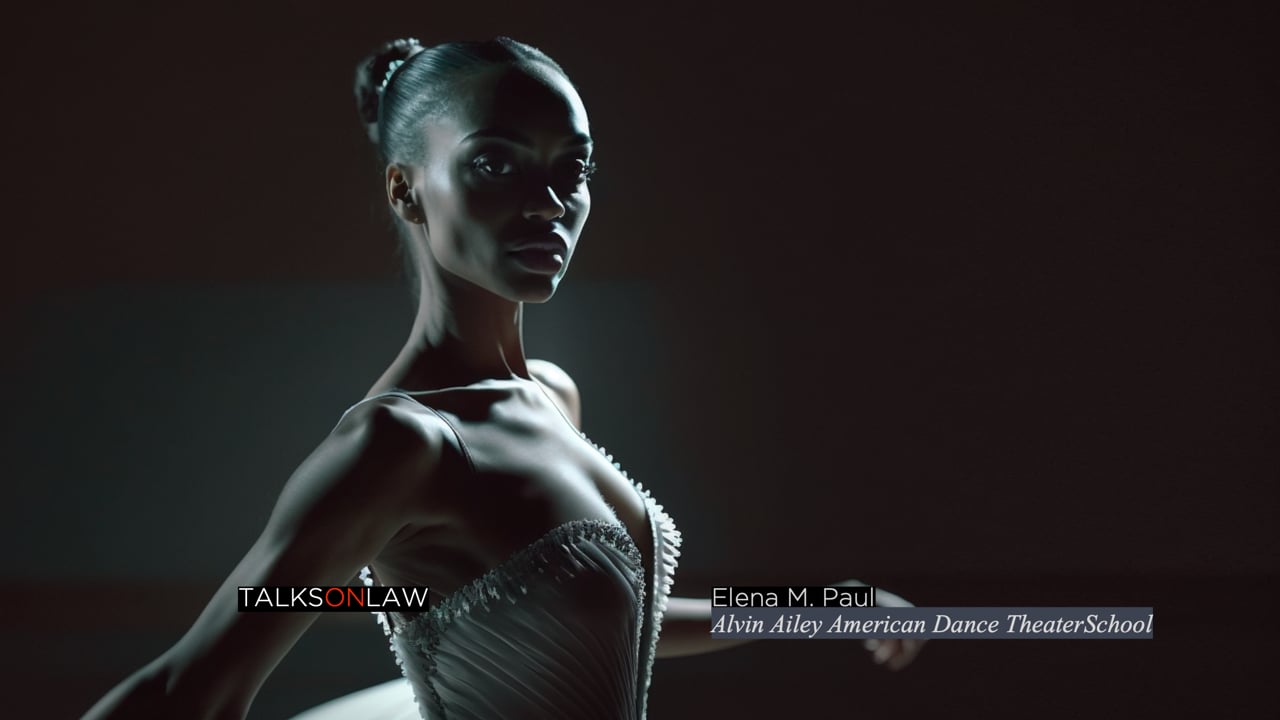
Dance as Intellectual Property
An interview with Elena M. Paul
The audience sees the dancers. Behind them stands the person who invented the steps, and behind that person a stack of contracts: a three-year license for the choreography, a lighting design bundled with the designer's services, music rights, union rules about bathtubs on tour, and a tax lawyer making sure the sponsor's name on the program does not turn into taxable advertising. Elite dance is art, but it is also a business — and, as it turns out, an intellectual property business.
In this TalksOnLaw interview, Joel Cohen sits down with Elena Paul, then general counsel of Alvin Ailey American Dance Theater and formerly executive director of Volunteer Lawyers for the Arts, for a tour of the legal architecture beneath a world-class dance company.
Who Owns a Dance?
Paul begins with the choreographer as author. A company like Ailey owns its founder's works outright and licenses new pieces from living choreographers, typically for three years — long enough to tour them. But a dance license is unlike a license to hang a painting on a film set: it almost always comes bundled with the choreographer's services, because the work is performed by human interpreters and the choreographer retains the right to say whether what is on stage is still his dance. You could draft a license permitting changes to a Balanchine ballet, she notes, but the Balanchine Trust would never let its name go on the result. The control is part copyright, part trademark, and part culture.
The Martha Graham Fight
The cautionary tale is the seven-year litigation over Martha Graham's repertory. Graham was at various times an employee of her own company and at others unpaid, and she left her estate to an outsider who eventually walked away with what he believed were her dances and her name. Under ordinary work-for-hire principles a company owns what its employees create; in dance, Paul explains, the culture ran the other way, and no one had thought to ask. The company ultimately kept the most valuable works, the costumes, and the name, but the case changed the field: Paul Taylor, Merce Cunningham, and others began doing the estate planning and asset structuring that had never seemed necessary, and a new generation of choreographers now arrives with the assets already separated into their own entities, fashion-house style, licensing to their own companies and to everyone else.
Dancers as Athletes, and as Union Members
Performers generally hold no rights in the works they dance. What they do hold is control over their image beyond the company's own promotion — a Gap commercial means a separate deal and separate pay — and the protections negotiated through their union, the American Guild of Musical Artists: hours, rest, travel, and the hotel bathtubs Paul must secure from every promoter. Cohen offers the sports-franchise analogy and Paul half-accepts it: the dancers are elite athletes representing millions of dollars of training, though without the salaries or the league's grip.
Nonprofit Economics and the Sponsorship Line
Ticket prices, as in opera, do not cover the cost of a performance, so major companies are tax-exempt nonprofits sustained by donors, government grants, and corporate sponsors — and increasingly by education programs filling the gap left when arts funding left the public schools. Paul walks through the tax line between acknowledging a sponsor and selling advertising: "generously supported by" is a qualified sponsorship; "the best soft drink" is unrelated business income. The problem, she notes, is that corporate slogans are now often trademarks with qualitative claims built in, and that sponsorship money increasingly comes from marketing departments rather than foundations.
Curtain at Eight
The last stretch is life on the road: costumes stuck in freight in Europe and the emergency negotiation with the choreographer and costume designer to dress a company from a local dance shop for one night; the four or five contracts that must be read before a choreographer can be told whether he gets house seats to his own premiere in San Francisco. Everything, Paul says, is aimed at one moment — eight o'clock on Tuesday — and the production department is, at bottom, a contracts department.
What to Know Now
The question at the heart of this conversation — what exactly is protectable in a dance — has since been litigated more in a decade than in the preceding half-century. In Bikram's Yoga College v. Evolation Yoga (2015), the Ninth Circuit held that a fixed sequence of yoga poses is an uncopyrightable system rather than a choreographic work, and the U.S. Copyright Office's 2017 guidance drew the line that short social dance steps and individual movements fall outside choreography, which doomed the first wave of suits by celebrities and social-media dancers over "emotes" sold in the video game Fortnite. The picture shifted in Hanagami v. Epic Games (2023), in which the Ninth Circuit reinstated a professional choreographer's infringement claim over a four-count phrase used in a Fortnite emote, rejecting the district court's pose-by-pose comparison in favor of an analysis that considers body position, timing, transitions, energy, and arrangement as a whole — the first appellate decision to give the choreography category real content, and one that has made licensing, rather than borrowing, the norm for games and platforms using recognizable moves. The viral-dance economy of TikTok has meanwhile made the credit and compensation questions Paul describes in the concert world a mainstream concern for young choreographers. The structural lessons of the Graham case have been fully absorbed: legacy trusts on the Balanchine and Cunningham models are now standard, and the for-profit asset-holding structures Paul saw emerging among European choreographers are common practice. At Ailey itself, Robert Battle stepped down in 2023 and Alicia Graf Mack, a former company dancer, became artistic director in 2024.
About Elena M. Paul
“In the production department of any major dance company is really all about contracts.”
Elena Paul is the former general counsel of Alvin Ailey American Dance Theater, one of the world's leading modern dance companies, where she oversaw legal and business affairs including choreography licensing, artist contracts, touring, and sponsorship. Prior to joining Ailey, she was executive director of Volunteer Lawyers for the Arts, where she acted as general counsel and legal adviser on a pro bono basis to arts and cultural organizations and individual artists, and before that executive director of Washington Area Lawyers for the Arts. She has served on the board of the SculptureCenter and taught as an adjunct professor in the producing and documentary programs at the New York Film Academy.