Governmental Power and Constitutional Liberty
An interview with Prof. Jeffrey Rosen
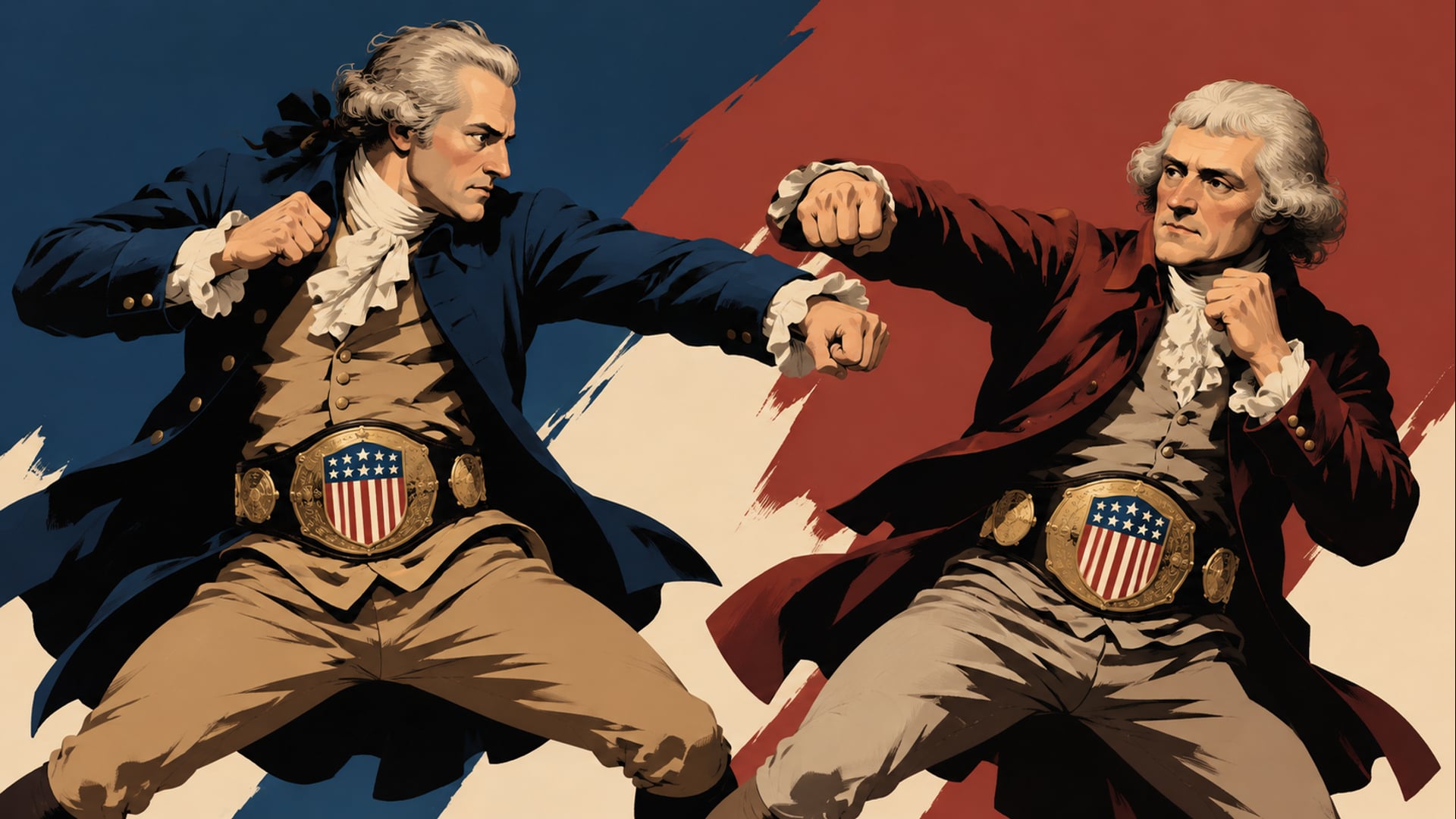
At a dinner party in 1791, Thomas Jefferson pointed to the portraits on his wall, Locke, Bacon, and Newton, and called them the greatest men in history. Alexander Hamilton replied that the greatest man who ever lived was Julius Caesar. From that exchange, Jeffrey Rosen argues, came America's two political parties and the argument that has defined every constitutional crisis since: Jefferson saw every increase in power as a threat to liberty; Hamilton believed power, properly structured, is what secures it. With a Supreme Court that now decides cases by competing accounts of history, that argument is no longer background reading. It is doctrine.
In this TalksOnLaw interview, Joel Cohen speaks with Jeffrey Rosen, CEO Emeritus of the National Constitution Center, which he led from 2013 to 2026, Professor of Law at The George Washington University, and author of The Pursuit of Liberty: How Hamilton vs. Jefferson Ignited the Lasting Battle Over Power in America, about the founders' three great debates (national power versus states' rights, democracy versus rule by elites, and liberal versus strict construction) and how they are being refought in the Supreme Court's 2026 decisions on birthright citizenship, the independent agencies, and presidential power.
Necessary and Proper
Rosen traces the fight over the Bank of the United States, where Jefferson read "necessary" to mean indispensable, Hamilton stayed up all night writing 14,000 words to read it as "useful," and John Marshall, with Hamilton's memo beside him, wrote the Hamiltonian view into McCulloch. He then follows the same question through the Louisiana Purchase, which Jefferson thought unconstitutional and made anyway, the Missouri Compromise and Dred Scott, the post-Civil War legal tender cases in which Congress shrank and re-expanded the Court to get the answer it wanted, and the Affordable Care Act. His conclusion: the real divide in American constitutional law is not originalism versus living constitutionalism but liberal versus strict construction, a divide that runs through today's originalists, with Scalia, Roberts, and Barrett on Hamilton's side and Thomas, Alito, and Gorsuch on Jefferson's. He explains why none of Jefferson, Hamilton, or Madison would qualify as an originalist today, and why Madison's willingness to change his mind ("Nothing, my dear, only a change of mind," his last words) is the better model.
Sovereignty, Secession, and Religion
Previewing his next book on the Constitutional Convention's four most frequent speakers, Rosen contrasts James Wilson's "We the People of the United States," Roger Sherman's compact of sovereign states, and Madison's dual sovereignty, and shows how those positions resurfaced in Jefferson's Kentucky Resolutions, Calhoun's defense of nullification, and Lincoln at Gettysburg. He connects the founders' religious disagreements, from Sherman's Puritan establishments to Madison's Memorial and Remonstrance, to Justice Gorsuch's 2026 rebuke of the claim that America is a "Christian nation."
Presidential Power from Roosevelt to Trump
Turning to Article II, Rosen sets Theodore Roosevelt's claim that the president may do anything the Constitution does not forbid against Taft's view that he may do only what it allows, and explains how the 1912 election fixed three competing visions of the administrative state that still sort American conservatives. He walks through the rise of governing by executive order, Myers v. United States and Brandeis's dissent ("not efficiency, but liberty"), the unitary executive theory from Hamilton's Pacificus letters to Reagan, and the Supreme Court's June 2026 decision in Trump v. Slaughter overruling Humphrey's Executor, in which the Chief Justice cited Rosen's biography of Taft, together with the companion ruling that kept the Federal Reserve's Lisa Cook in office. He closes with the question his book leaves open, whether the current president is a Caesar or an Andrew Jackson, with the 1800 election, Burr's conspiracy, and the duel at Weehawken, and with the bust of Hamilton that Jefferson kept facing his own at Monticello: "opposed in life as in death," a rival to be engaged rather than destroyed.
Additional Resources
Books by Jeffrey Rosen
- The Pursuit of Liberty: How Hamilton vs. Jefferson Ignited the Lasting Battle Over Power in America (Simon & Schuster, 2025): The book discussed in this program, tracing the Hamilton–Jefferson debates over liberty and power from the Bank of the United States to the present.
- The Pursuit of Happiness: How Classical Writers on Virtue Inspired the Lives of the Founders and Defined America (Simon & Schuster, 2024): The first volume of the Founders Trilogy.
- William Howard Taft (Times Books, The American Presidents series, 2018): Rosen's biography of Taft, cited by Chief Justice Roberts in Trump v. Slaughter.
- Louis D. Brandeis: American Prophet (Yale University Press, 2016).
Founding Documents
- U.S. Constitution, Article I, § 8, cl. 18 (Necessary and Proper Clause) and Article II, § 1 (Vesting Clause): The two provisions at the center of the liberal-versus-strict-construction and unitary-executive debates.
- Jefferson, Opinion on the Constitutionality of a National Bank (Feb. 15, 1791) and Hamilton, Opinion on the Constitutionality of an Act to Establish a Bank (Feb. 23, 1791): The dueling memos to President Washington on the meaning of "necessary and proper."
- Hamilton, Pacificus No. 1 (1793) and Federalist No. 77: The sources for Hamilton's views on executive power and on removal, debated by the majority and dissent in Trump v. Slaughter.
- Kentucky Resolutions (1798, Jefferson) and Virginia Resolutions (1798, Madison): The responses to the Alien and Sedition Acts that introduced nullification and strict construction of the First Amendment.
- Madison, Memorial and Remonstrance Against Religious Assessments (1785): Madison's statement that freedom of conscience is unalienable.
- Taft, Our Chief Magistrate and His Powers (1916) and Theodore Roosevelt, An Autobiography (1913), ch. 10: The competing "chief magistrate" and "stewardship" theories of presidential power.
Cases: Construction and Congressional Power
- McCulloch v. Maryland, 17 U.S. (4 Wheat.) 316 (1819): Chief Justice Marshall adopts Hamilton's reading of the Necessary and Proper Clause.
- Dred Scott v. Sandford, 60 U.S. (19 How.) 393 (1857): Strict construction of the Territory Clause invalidates the Missouri Compromise; Justice Curtis's dissent.
- Hepburn v. Griswold, 75 U.S. 603 (1870), and the Legal Tender Cases, 79 U.S. 457 (1871): The Court reverses itself on paper money within fifteen months after two new appointments.
- NFIB v. Sebelius, 567 U.S. 519 (2012): The Affordable Care Act upheld under the taxing power.
- Loper Bright Enterprises v. Raimondo, 603 U.S. 369 (2024): Chevron deference overruled.
- Trump v. Barbara (June 30, 2026): Executive Order 14160 on birthright citizenship held unconstitutional; competing historical accounts of the Citizenship Clause in the majority and dissent.
Cases: Presidential Power and Removal
- Myers v. United States, 272 U.S. 52 (1926): Chief Justice Taft upholds the President's power to remove a postmaster; Justice Brandeis's dissent on separation of powers as a safeguard of liberty.
- Humphrey's Executor v. United States, 295 U.S. 602 (1935): For-cause removal protection for FTC commissioners upheld.
- Morrison v. Olson, 487 U.S. 654 (1988): Independent counsel statute upheld; Justice Scalia's dissent.
- Seila Law LLC v. CFPB, 591 U.S. 197 (2020): For-cause protection for a single agency director held unconstitutional.
- Trump v. Slaughter (June 29, 2026): Humphrey's Executor overruled; the President may remove FTC commissioners at will.
- Trump v. Cook (June 29, 2026): Federal Reserve governor's for-cause protection preserved pending litigation; notice and hearing required before removal.
- Worcester v. Georgia, 31 U.S. 515 (1832): The decision behind the apocryphal "let him enforce it" quotation attributed to Andrew Jackson.
Further Reading
- Amy Coney Barrett, Listening to the Law: Reflections on the Court and the Constitution (2025): Justice Barrett's account of originalism and its limits, discussed in the program.
- Herbert Croly, The Promise of American Life (1909): Source of "Hamiltonian means for Jeffersonian ends," Theodore Roosevelt's New Nationalism slogan.
- National Constitution Center, Interactive Constitution (constitutioncenter.org): Clause-by-clause commentary from scholars of differing views, including the Necessary and Proper Clause and Article II.
- National Constitution Center, "We the People" podcast: The Center's weekly program on constitutional debates, hosted by Rosen during his tenure as President and CEO.
- Prior TalksOnLaw programs with Jeffrey Rosen: See the speaker page for earlier conversations on privacy, the Supreme Court, and the founders.
About Prof. Jeffrey Rosen
“It is an unreasonable search of our persons and digital effects to track our movements 24/7 without a warrant.”
Jeffrey Rosen is CEO Emeritus of the National Constitution Center, which he led as President and CEO from 2013 to January 2026, and a Professor of Law at The George Washington University. He is a contributing editor of The Atlantic, and his essays and commentaries have appeared in The New York Times Magazine, on National Public Radio, and in The New Yorker, where he was a staff writer. Professor Rosen is the author of several books, including Louis D. Brandeis: American Prophet and The Pursuit of Happiness: How Classical Writers on Virtue Inspired the Lives of the Founders and Defined America. The Chicago Tribune named him one of the 10 best magazine journalists in America and The L.A. Times called him "the nation's most widely read and influential legal commentator."