Bourbon is one of the most closely regulated products Americans buy. Federal law dictates its ingredients, proof, and aging containers, and forbids any additive other than water. Behind those rules lies more than a century of lawsuits and legislation over who may use a famous name, what a label may promise, and how to protect drinkers from adulterated whiskey. Those fights produced principles that reach well beyond the bottle.
In this TalksOnLaw interview, Joel Cohen sits down with Brian Haara, a partner at Fultz Maddox Dickens PLC in Louisville, Kentucky, author of Bourbon Justice: How Whiskey Law Shaped America, and writer of the bourbon law blog Sipp'n Corn, to explore how bourbon is legally defined and how disputes among distillers helped shape American trademark, consumer protection, and false advertising law.
What Makes Bourbon Bourbon
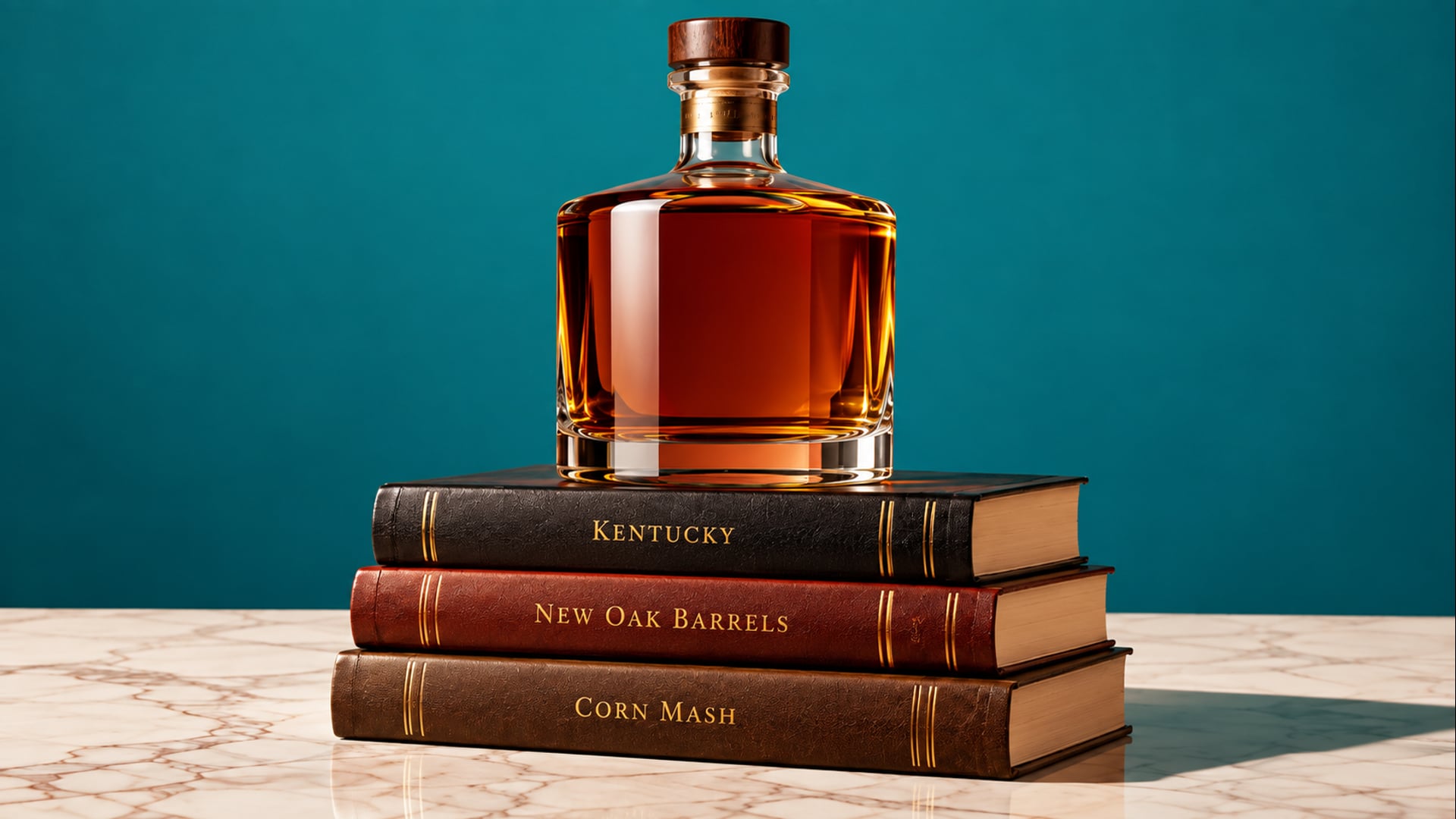
Bourbon's definition now sits in the Code of Federal Regulations, Haara explains. It must be made from at least 51 percent corn, distilled to no more than 160 proof so that the grain flavor survives, entered into its container at no more than 125 proof, and bottled at no less than 80 proof. The rules call for "charred new oak containers," not barrels as such, and because the wood is used only once, spent bourbon barrels go on to age Scotch and tequila. Unlike Scotch, which may contain added coloring, bourbon may contain nothing but pure water. Its flavor must come from the grain, the yeast, and the barrel, so honey- and cinnamon-flavored whiskeys may start as bourbon but cannot be sold as bourbon.
Brand Names and the First Trademark Fights
Before bourbon was bottled, it was shipped to taverns in barrels whose heads bore the distiller's name, burned into the wood. Customers began asking for whiskey by that name, which, Haara says, is where the term "brand name" comes from. Old Crow, made famous by the Scottish-born chemist James Crow at the Old Oscar Pepper Distillery near Versailles, Kentucky, was the leading bourbon of the 19th century, and its success drew imitators with names like Old Raven and Old Jay. The resulting lawsuits helped define when a new brand gets too close to an established one. After Crow's death, Colonel E.H. Taylor, Jr. carried the name to a new Old Crow Distillery, while the Old Oscar Pepper Distillery passed through bankruptcy to Labrot & Graham, whose property is today's Woodford Reserve. When Oscar Pepper's son James sued over the Pepper name, the court held in Pepper v. Labrot (1881) that the new owner could keep calling the property the Old Oscar Pepper Distillery because the name accurately identified that place.
Family Names and Red Wax
Name fights often pit an established brand against a descendant who wants to use the family name. The instinct that anyone may use his own name gives way when that use would confuse consumers, a theme that runs through the Lanham Act. Maker's Mark tells visitors that Bill Samuels Sr. burned the family recipe to create a new, wheated bourbon. In Haara's account, Samuels first wanted to use his own name and was sued by the company that by then owned the historic T.W. Samuels brand, so he and his wife, Margie, came up with Maker's Mark and its dripping red wax. That wax later produced its own case. After a Jose Cuervo tequila appeared with a dripping red wax seal, Maker's Mark sued in federal court in Louisville, which held that the red dripping wax was a protectable trademark and that the tequila's seal was likely to confuse consumers.
Bourbon and the Birth of Consumer Protection
Haara calls the Bottled-in-Bond Act of 1897 the country's first consumer protection law, predating federal action on the adulterated milk, candy, and meat that Upton Sinclair's The Jungle helped expose. "Rectifiers" of the era took flavorless high-proof spirits and doctored them to resemble aged bourbon, reportedly with tobacco juice, crushed insect shells, and acids. The Act offered a government-backed guarantee: bottled-in-bond whiskey had to come from one distiller at one distillery in one distilling season, be aged at least four years, be bottled at 100 proof, and contain no additives. The Pure Food and Drug Act of 1906 added broader rules but did not end the fight between straight whiskey producers such as Colonel Taylor and the rectifiers. That fell to President William Howard Taft, whose 1909 decision, as Haara describes it, let rectifiers keep selling their product but required them to call it imitation whiskey rather than straight bourbon.
Labels, Puffery, and Undefined Terms
False advertising law has bourbon roots too. Distillers that abandoned open-fire copper stills kept advertising the old method until courts called them out, and Haara draws a line from those cases to modern disputes over Skechers' toning-shoe ads and Listerine's comparison to floss. Several popular label terms have no legal definition. "Small batch" might mean a dozen barrels or 500. "Single barrel" is clearer, though topping off or re-barreling for finishing raises questions. "Handmade" drew class actions against Maker's Mark in Florida and California, which the distillery won because no reasonable consumer would think bourbon is literally made by hand, the kind of claim the puffery doctrine protects. "Craft," in Haara's view, is effectively meaningless. He also flags "finishing" in casks that once held sherry, rum, or cognac. Because bourbon's flavor may come only from grain, yeast, and the barrel, he sees finishing as a kind of additive.
Assumed Names and Sourced Whiskey
Some labels suggest distilleries that do not exist. There is no Old Rip Van Winkle distillery, Haara notes; the prized Van Winkle bourbons are made under contract at a distillery in Frankfort. Courts generally accept assumed names, he says, but the risk grows when a brand hides where its whiskey comes from. Templeton Rye marketed a Prohibition-era Iowa recipe and an Al Capone story while buying its rye from MGP in Indiana, and it was sued in a consumer class action. Bourbon trademark litigation remains active, he concludes, pointing to a recent Western District of Kentucky injunction in favor of Heaven Hill, owner of the Dant brand, against a new distillery founded by a Dant descendant that invoked the year 1836 and promised to revive the J.W. Dant legacy.
What to Know Now
The Alcohol and Tobacco Tax and Trade Bureau (TTB) reorganized its spirits labeling rules in 2022, moving the bourbon standard to 27 C.F.R. § 5.143 without changing its core requirements. Under TTB guidance, bourbon further aged in a used wine or spirits cask no longer meets the standard and is labeled as a distilled spirits specialty, for example "bourbon whisky finished in sherry barrels." TTB's January 2025 proposals for mandatory "Alcohol Facts" and allergen labeling remain pending, with final rules projected for 2027. In Jack Daniel's Properties, Inc. v. VIP Products LLC (2023), the Supreme Court held that the speech-protective Rogers test does not apply when a parody is used as a brand, though on remand the dog-toy parody was found not to confuse consumers, and in August 2026 the Ninth Circuit rejected Jack Daniel's remaining dilution claim. Trade policy has become the industry's largest legal concern. The EU removed American whiskey from its April 2025 countermeasures list after the President threatened a 200 percent tariff on European wine and spirits, and it has kept a later package reaching U.S. spirits suspended, since July 2026 without an end date. Most Canadian provinces pulled American spirits in March 2025, exports to Canada fell about 70 percent, and in September 2026 the United States, citing discrimination against U.S. alcohol, announced a ban on certain Canadian alcoholic beverages effective September 29. Canadian officials tie the provincial bans to U.S. tariffs. Kentucky began phasing out its tax on aging barrels in 2026, a change distillers say keeps inventory in the state and local governments say costs them revenue. Heaven Hill and Log Still Distilling later settled the J.W. Dant trademark dispute.
A few details from the conversation are worth stating precisely. Taft's 1909 decision did not require rectified products to be called "imitation whisky." It allowed them to be sold as whisky if labeled accurately, for example as "whisky made from neutral spirits" or as a blend. The Skechers ads challenged by the Federal Trade Commission used Joe Montana, not Joe Namath, as an endorser, and the Listerine ads claimed the rinse was "as effective as floss," not better than floss.