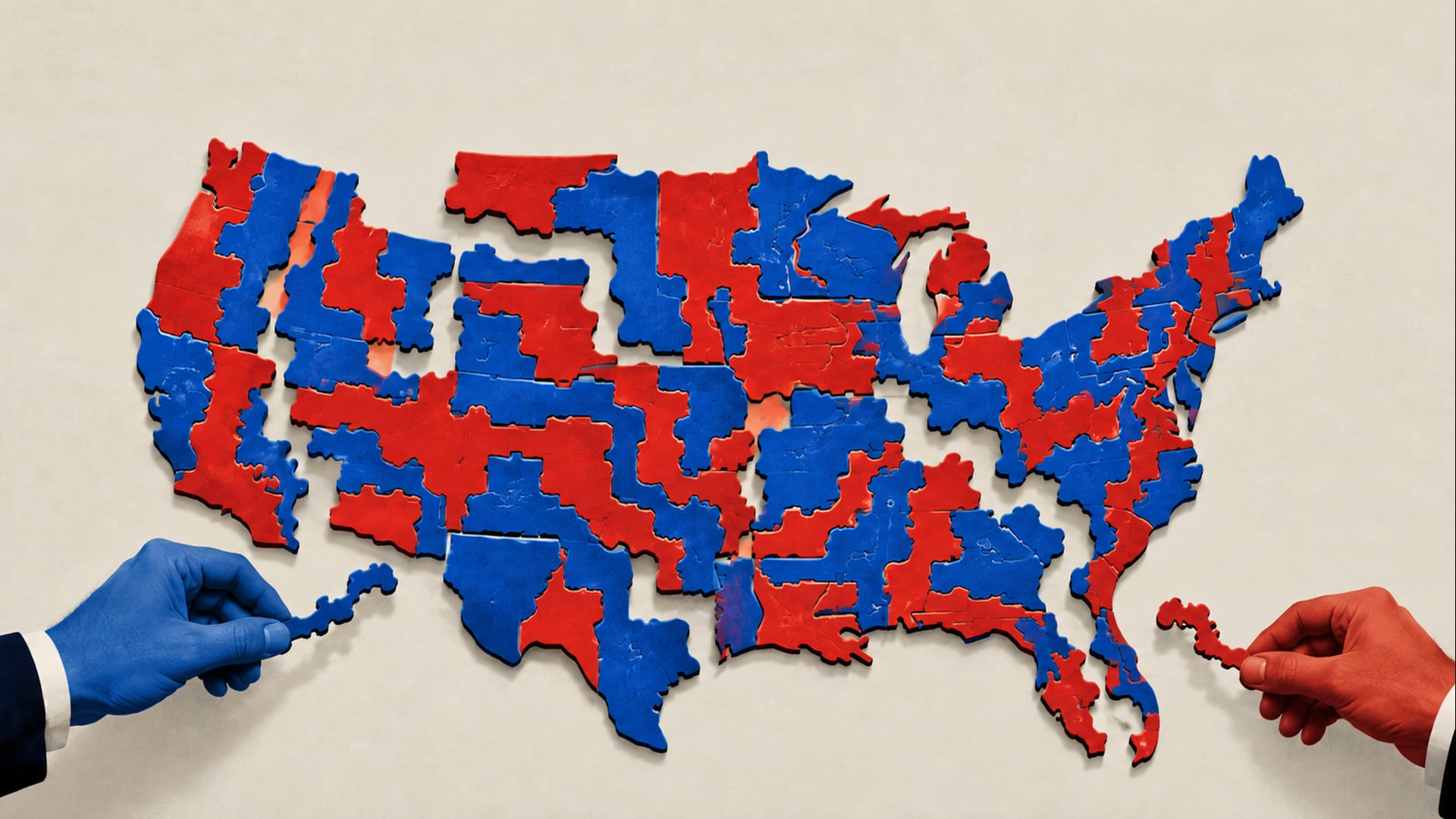
Democracy is supposed to be the process by which voters choose their representatives. Gerrymandering is the process by which representatives choose their voters. For decades the practice was at least nominally constrained: maps were drawn once a decade, after the census, under the threat that a federal court might strike down the worst of them. That threat ended in 2019 with Rucho v. Common Cause. The once-a-decade norm ended in 2025, when the President urged red states to redraw mid-decade and California answered in kind. And in 2026, Louisiana v. Callais stripped the Voting Rights Act of most of its remaining force in redistricting. The result, in the words of this program's guest, is a world of "no holds barred gerrymandering."
In this TalksOnLaw interview, Joel Cohen speaks with Nicholas Stephanopoulos, Kirkland & Ellis Professor of Law at Harvard Law School and Director of Strategy of the HLS Election Law Clinic, about how gerrymanders are built, why the Supreme Court walked away from policing them, what the race cases do and don't reach, and what, if anything, can still fix it. Stephanopoulos co-created the "efficiency gap," the measure of partisan bias at the center of Gill v. Whitford, and was deeply involved in both Gill and Rucho, the two cases in which the Court confronted partisan gerrymandering and then pulled away.
Cracking, Packing, and the Efficiency Gap
Stephanopoulos explains the two techniques behind every modern gerrymander: cracking, which spreads the other side's voters across districts they consistently lose, and packing, which concentrates them in a few districts they win by wasteful margins. He shows why line drawers combine the two for a map that is both aggressive and durable, why Elbridge Gerry's original salamander lasted only a year while today's gerrymanders persist, and why the weird shapes that gave the practice its name are no longer necessary. He walks through the efficiency gap, the single-number measure of wasted votes that he and political scientist Eric McGhee built to answer Justice Kennedy's call for a quantitative standard, and what the metric cannot tell you on its own: whether the bias comes from deliberate line drawing or from where partisans happen to live.
Gill, Rucho, and the Court That Walked Away
From the inside, Stephanopoulos recounts the Wisconsin litigation that became Gill v. Whitford: the activists who found his draft article, the trial court that became the first since Davis v. Bandemer to strike down a map as a partisan gerrymander, the Supreme Court's remand on standing, and Justice Kennedy's retirement days later ("all our hopes went up in flames"). He explains why a strategy built around Kennedy's stated preferences produced a deliberately modest test, and why the move from Kennedy to Roberts as the Court's median decided Rucho. He then takes apart the Rucho majority's "redistricting exceptionalism," the one-person, one-vote cases that show the Court knows how to work out a line over time, and Justice Kagan's dissent as one of the great political-process-theory opinions in the Court's history.
Race, Callais, and What Is Left
Stephanopoulos separates two theories that are routinely confused: racial gerrymandering, a colorblindness doctrine that bars drawing districts for a predominantly racial purpose, and racial vote dilution, the Voting Rights Act theory that is the true analog to partisan gerrymandering. He explains why "party, not race" is now a complete defense, why savvy line drawers never need racial data when they have precinct returns, and why the doctrine has turned "totally upside down," with naked partisan maps in the clear and good-faith efforts to represent minority voters exposed to liability. He describes Louisiana v. Callais and the requirement that plaintiffs' proposed maps satisfy the state's partisan goals, which he expects to end Section 2 liability for vote dilution and to produce the least minority representation in decades in the 2030 cycle. The conversation closes with the remaining checks (state courts and the Purcell principle, voter referendums, Congress) and his fixes: a uniform federal rule, independent commissions on the Australian model, expanding the House, and proportional representation as the only durable answer.