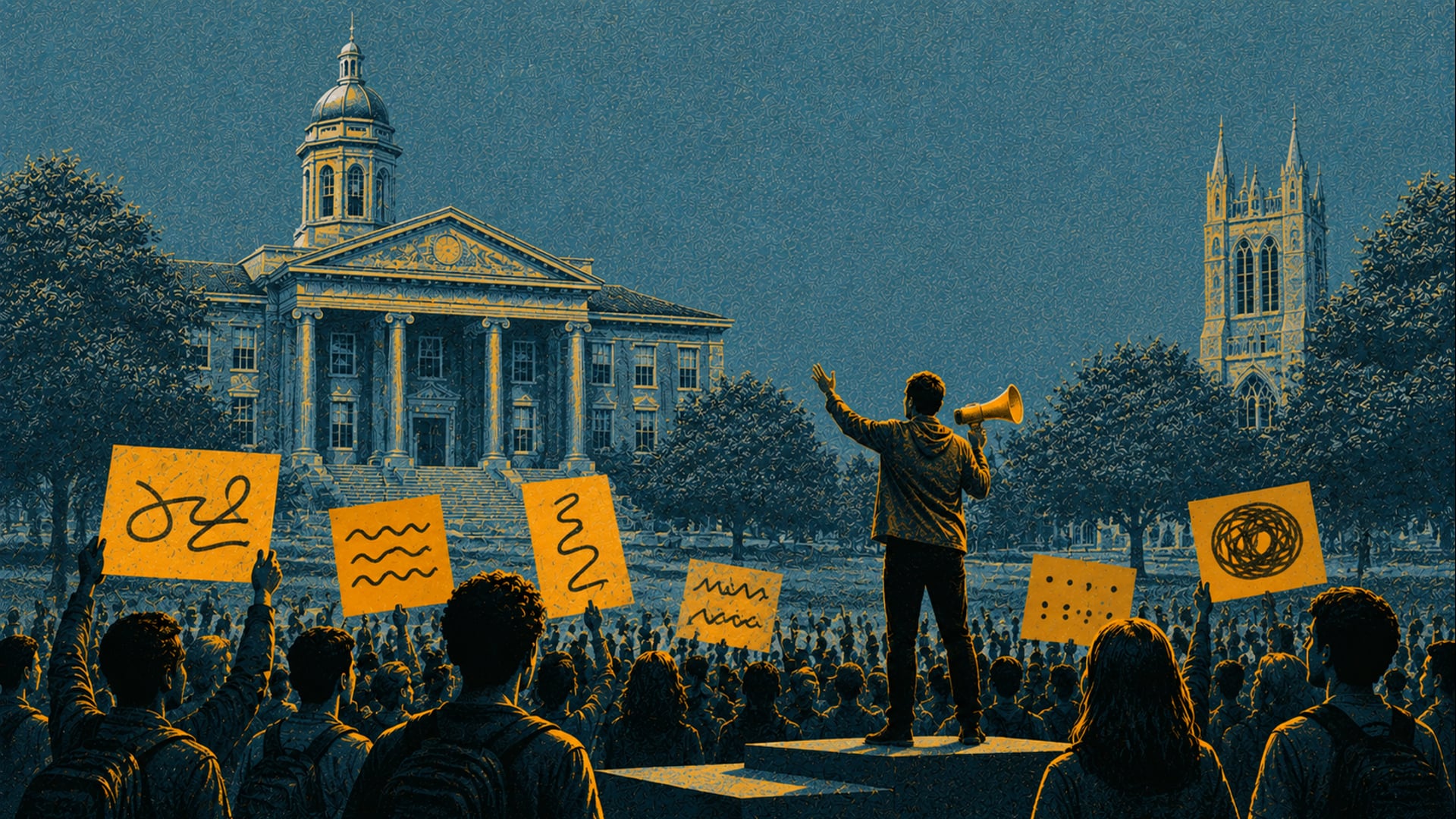
Law schools train students to argue both sides of hard questions in classrooms where contested ideas can be voiced and answered. What should happen when students object to a professor's words, when invited speakers are shouted down, or when faculty quietly skip difficult subjects? And where does protected speech end and harassment begin?
In this TalksOnLaw interview, Joel Cohen sits down with Russell K. Osgood, Professor of Law and former dean of Washington University in St. Louis School of Law (WashU Law), former president of Grinnell College, and former dean of Cornell Law School, to discuss open discourse in American law schools and why he believes robust, varied speech is essential to training good lawyers.
Why Law School Needs Wide-Open Debate
Osgood, who has taught for more than four decades, says speech disputes became a significant issue only in recent years, in disruptions of guest speakers and in classrooms, where students occasionally object to a word or topic drawn from a court decision or statute. Because law schools teach the political order expressed in documents like the Constitution, he argues, a wide ambit for free speech is indispensable, even for speech some people strongly oppose. People occasionally change their minds, so they need to hear other views, and bad ideas are refuted only when someone confronts them with better ones. As for students who cast disruption as civil disobedience, he notes that they usually insist they should not be punished at all. His answer is not punishment but engagement.
Where Osgood Draws the Line
Osgood would wall off two kinds of expression. The first is harassment aimed at a particular person. A professor who calls one comment "dumb" has chosen words poorly, he explains, but harassment requires a pattern, such as repeatedly holding up the same student as an example of foolishness. The second, on which he acknowledges not all professors agree, is the use of widely recognized slurs in class. Some law professors have spoken the full n-word while discussing cases, and Osgood finds that unacceptable because it is not discourse but a humiliating racial insult. He would never edit a judicial opinion, but the word should not be spoken in the classroom. When complaints arise, he calls the professor promptly, without naming the student, and most professors apologize to the class. Deans generally cannot fire tenured faculty, whose tenure can be revoked only through faculty-run proceedings.
Speakers and the Heckler's Veto
Osgood has seen few faculty firings over speech, citing a Georgetown matter involving a recorded Zoom conversation as one of only a couple that drew national attention. More common is pressure to withdraw invitations to speakers who once said something unsavory. If the invitee presents a legitimate point of view that would enrich discourse, he says, the invitation should stand, and deans should not censor whom student groups invite. Objecting students should attend, ask pointed questions, and listen to the answers. At both schools he has led, students did so, and the speakers expressed regret for past remarks. Discussing Berkeley Law Dean Erwin Chemerinsky's argument that there is no right to a heckler's veto, Osgood agrees that shouting down a speaker is wrong. Speakers, in turn, should take questions from critics.
Words in the Classroom
While Osgood was teaching Roe v. Wade and Planned Parenthood v. Casey, with Dobbs then pending, two students asked him to say "unborn child" rather than "fetus," the opinions' term. Later a student objected to "alien," the term in the Immigration and Nationality Act, and asked for "migrant." Osgood described the first request and asked how one side could get its way and not the other; the student later allowed there was "something" to the point. Such requests often come from empathy, Osgood agrees, but the better response is argument. When a student objected to Casey, he urged her to criticize it in class, and she did, which is exactly what should happen.
Teaching the Hard Topics
Some colleagues have told Osgood they skip rape in criminal law, both because some students are survivors and because views diverge sharply on what the law should be. He thinks avoidance is a mistake. Rape law has moved from a common-law force requirement toward definitions centered on consent, and he expects further change. Osgood does not give formal trigger warnings, though he flags disturbing cases, and when a student who had experienced sexual assault asked not to be called on, he agreed. He spends extra time on qualified immunity and police use of force, which some colleagues avoid as too complicated. Because many students start out opposing any immunity, he uses simple hypotheticals, or New York's detailed statutory rules on justification, to show where immunity may be warranted and where it is not. One asks whether an officer justified in using deadly force may keep firing 14 times. The law, he says, has not done well at defining disproportionate deadly force.
Social Media and Student Speech
Osgood credits social media with helping prospective students assess a school and with drawing attention to excessive police violence against African Americans, even when posts overstate the facts. Deans, he says, are fair game for criticism, and faculty must accept some too. What troubles him is students posting false or demeaning claims about classmates based on what they said in class. Because participation is required, fear of being "roasted" online chills it, and he believes conduct codes should address that. Posts unrelated to class are beyond a law school's concern.
Tenure, Academic Freedom, and Alumni
Tenure protects a "hugely broad domain" for faculty speech, Osgood explains, because ideas that seem outrageous in one generation, such as same-sex marriage, can become law in the next. Academic freedom does not cover racially demeaning comments, and faculty handbooks govern the rare tenure proceedings, though many universities have not drafted them clearly. Most faculty facing such proceedings resign or retire. Fewer than five times in his career has anyone threatened to withhold gifts for political reasons, and when an alumna called, upset about President Trump's travel ban, he engaged with her at length. Anything that limits free speech in an academic institution, he concludes, "is a disaster."
What to Know Now
Law schools became flashpoints for these debates. After 2022 disruptions at UC Hastings (now UC Law San Francisco) and Yale, two federal judges announced they would stop hiring Yale Law clerks, and in 2023 students shouted down Judge Kyle Duncan at Stanford Law School, which then required free speech training. In February 2024, the ABA adopted Standard 208, requiring every accredited law school, public or private, to protect academic freedom and the expression of controversial ideas while prohibiting disruption of school functions. After October 7, 2023, protests over the war in Gaza and reports of antisemitism brought Title VI investigations, a warning letter to law deans from large law firms, rescinded job offers, a dispute over a Columbia Law Review article, a confrontation at a student dinner at Dean Chemerinsky's home, and a 2024 pledge by thirteen judges not to hire Columbia clerks. Many universities, including WashU, adopted institutional neutrality policies, and Ohio mandated them by statute. In 2025, federal funding freezes led to settlements and lawsuits, the government moved against some noncitizen student protesters, and after Charlie Kirk's assassination, dozens of faculty and staff were disciplined or fired over comments about his death. On September 8, 2026, the ABA's accrediting council voted 10–6 to repeal Standard 206, its diversity requirement, after the Texas and Florida supreme courts ended exclusive reliance on ABA accreditation.
Supporters see overdue enforcement against disruption and harassment and a needed commitment to viewpoint diversity. Critics, including the American Association of University Professors, warn that neutrality policies can mask value choices and that funding pressure and punishment of protesters and faculty chill speech. A few points need updating. Osgood stepped down as dean in June 2024 and remains on the faculty. Dobbs (2022) overruled Roe and Casey. Qualified immunity is a defense to civil damages claims, not to criminal prosecution, where officers rely on statutory justification defenses. The Supreme Court has held that officers justified in firing need not stop until the threat ends, Plumhoff v. Rickard (2014), and that force must be judged under the totality of the circumstances, Barnes v. Felix (2025). The first travel ban was upheld in 2018 and revoked in 2021, and new restrictions followed in 2025.