The Constitution gives Congress the power over immigration. In practice, the president runs it. Roughly 22 million noncitizens live in the United States, nearly 11 million of them deportable at any time, and whether they are deported, left alone, or granted protection has depended for decades on the enforcement choices of whoever occupies the White House. How did a system in which Congress writes the law come to put the president in the driver's seat?
In this TalksOnLaw interview, recorded in December 2020 at the end of President Trump's first term, Joel Cohen speaks with Adam Cox, the Robert A. Kindler Professor of Law at NYU School of Law, and Cristina Rodríguez, then a professor at Yale Law School and now its Dean, co-authors of The President and Immigration Law, about how the "shadow" immigration system was built, what it lets presidents do, and whether it can be reformed.
How the Shadow System Was Built
Cox and Rodríguez describe three twentieth-century shifts: the rise of a "deportation state," the growth of an enforcement bureaucracy that now receives more resources than all other federal law enforcement combined, and the surge in unauthorized migration after 1970. The end of the Bracero program and the imposition of per-country quotas, they explain, "turned a lot of migration that used to be lawful migration into unlawful migration," and harder border crossings turned a circular workforce into a settled population. Early deportation statutes had one-year limitation periods; those were relaxed and then eliminated, so that anyone who entered without inspection or overstayed a visa is now perpetually removable. The post-9/11 creation of DHS and ICE, and partnerships with state and local police through programs like Secure Communities, pushed removals to about 400,000 a year, more people than the entire federal prison population.
The Throttle and the Steering Wheel
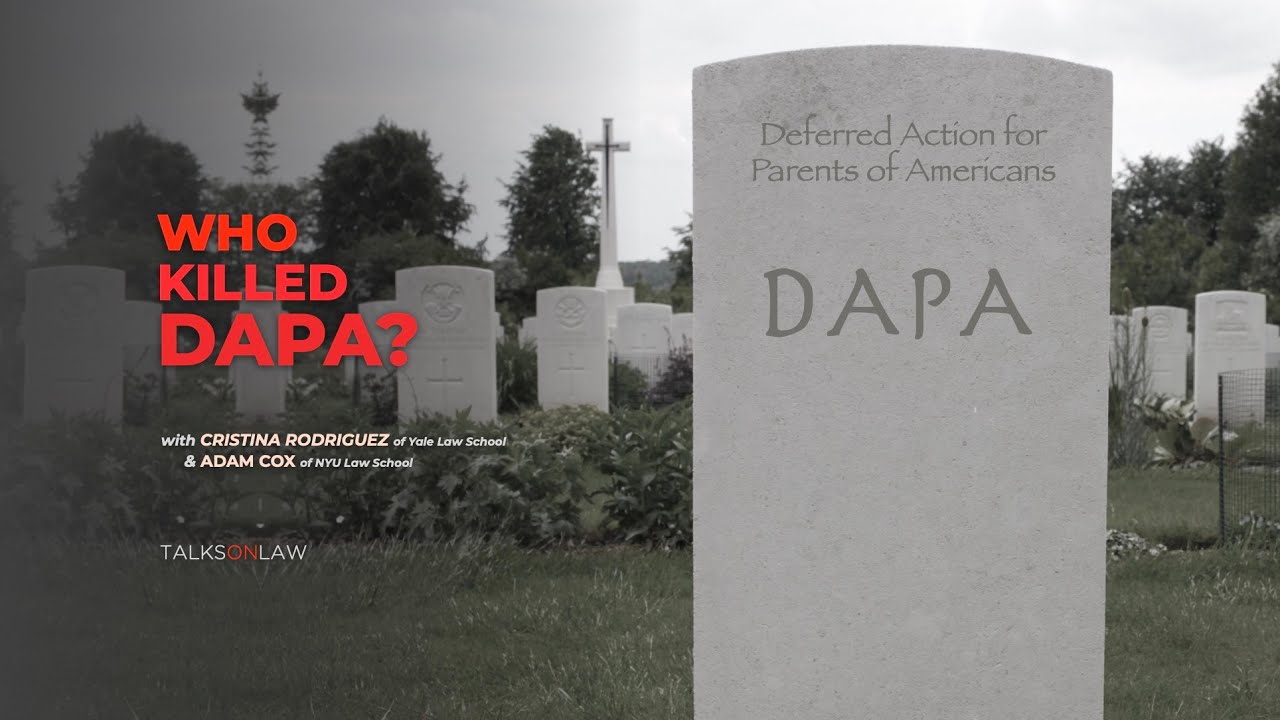
Because the law makes far more people deportable than any administration could remove, presidents decide who actually goes. Enforcement-priority memos date to the Ford administration, and the authors trace how that discretion evolved from a throttle into a steering wheel. They recount the creation of DACA, prompted in part by line agents' resistance to the Obama administration's priorities, and the move of its adjudication from ICE to USCIS; the DAPA program for parents, enjoined by a judge in Texas and left in place by a 4–4 Supreme Court after Justice Scalia's death; the ICE union's lawsuit against its own secretary; and the first Trump administration's rescission of DACA, which the Supreme Court blocked in DHS v. Regents (2020) for failure to consider reliance interests.
The Courts and the Road to Reform
The authors examine the judiciary's historically deferential role, from the plenary-power doctrine of the Chinese Exclusion era, which developed alongside Plessy, to Trump v. Hawaii (2018), which upheld the travel ban under Section 212(f), and Thuraissigiam (2020), which curtailed habeas review of expedited removal. They discuss the parole power that invented refugee policy for Hungarians in 1956, the pandemic-era Title 42 asylum shutdown, and why presidential power over immigration is "neither unequivocally good nor bad." Their prescription is to shrink the shadow system itself: a system that makes fewer people deportable gives the president less to decide.
What to Know Now
The dynamic Cox and Rodríguez describe has only intensified. The Biden administration issued new enforcement priorities in 2021; when Texas and Louisiana challenged them, the Supreme Court held in United States v. Texas (2023) that the states lacked standing, leaving enforcement discretion with the executive. DACA has remained in litigation: after Regents, the Biden administration codified the program in a 2022 rule, a federal district court held it unlawful, and the Fifth Circuit in 2022 and again in January 2025 upheld deferred action itself while finding the work-authorization component likely unlawful. Only renewals are being processed, and the case remains on remand. The undocumented population was estimated at a record 14 million in 2023, and the Title 42 expulsions discussed here ended in May 2023.
President Trump's second term, beginning in January 2025, has tested the limits of executive power the authors analyze: the rescission of prior enforcement priorities, nationwide expansion of expedited removal, a large expansion of state and local 287(g) partnerships, new travel-ban proclamations under the same Section 212(f) authority upheld in Trump v. Hawaii, termination of the Biden-era parole programs for more than half a million people, which the Supreme Court allowed to proceed in May 2025, and termination of Temporary Protected Status for Venezuelans, which the Court also allowed to take effect. The administration invoked the Alien Enemies Act of 1798 for the first time since World War II; the Supreme Court held in Trump v. J.G.G. (2025) that detainees must receive notice and an opportunity to seek habeas review, and the Fifth Circuit's challenge to the invocation itself was dismissed as moot in 2026, leaving the Act's scope unresolved. ICE removals rose to roughly 320,000 to 340,000 in fiscal 2025. In Trump v. CASA (2025) the Court curtailed universal injunctions, and in Trump v. Barbara (June 2026) it held the executive order limiting birthright citizenship unconstitutional. Congress has still not enacted comprehensive immigration reform or legalization for Dreamers. Cristina Rodríguez became the 18th Dean of Yale Law School on February 1, 2026.